Logical Alarms for Misaligned Classifiers
The power of logic alone as an aid for AI safety is demonstrated by the algorithms in the ntqr.alams module. This notebook provides some examples demonstrating their use.
Binary classification, the R=2 case
# The basic unit of the alarms are comparisons between pairs of classifiers
# in an ensemble. For each classifier we create its individual axioms
labels = ['a', 'b']
c1axioms = ntqr.r2.raxioms.SingleClassifierAxioms(labels, 'i')
c2axioms = ntqr.r2.raxioms.SingleClassifierAxioms(labels, 'j')
# Let's make an alarm for a small test, Q=10 questions.
alarm = ntqr.alarms.SingleClassifierAxiomsAlarm(10,
                                               (c1axioms, c2axioms),
                                               ntqr.r2.evaluations.SingleClassifierEvaluations)
# We want the classifiers to be better than 1/2 for both labels
alarm.set_safety_specification([2,2])
# Let's first look at a test where these two pairs are misaligned. The misalignment trace
# gives us the number of question types and whether one or more of the classifiers fail
# the safety specification (> 50%) at the assumed number of question types.
%pprint
list(alarm.misalignment_trace([(2,8),(8,2)]))
Pretty printing has been turned OFF
[((10, 0), True), ((5, 5), True), ((0, 10), True), ((6, 4), True), ((4, 6), True), ((2, 8), True), ((3, 7), True), ((1, 9), True), ((9, 1), True), ((8, 2), True), ((7, 3), True)]
# We can check visually for the misalignment
ntqr.plots.plot_pair_logical_alarm_at_qs(labels, ['i','j'], (6,4), [(2,8),(8,2)], plt=plt)
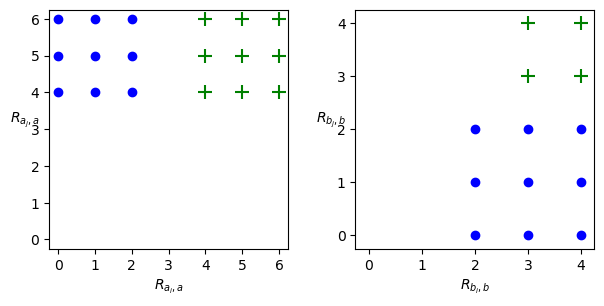
At the assumed number of questions \((Q_a = 6, Q_b = 4),\) there are no evaluations for either of these classifiers that have both of them hitting the green cross points - the points that satisfy the safety specification.
# Let's now try pair responses that cannot conclusively prove the pair is misaligned.
alarm.misalignment_trace([(2,8),(3,7)])
{((1, 9), False), ((10, 0), True), ((5, 5), True), ((6, 4), True), ((4, 6), True), ((0, 10), False), ((9, 1), True), ((8, 2), True), ((7, 3), True), ((3, 7), False), ((2, 8), False)}
These classifier responses have question settings (e.g. (2,8)) where the pair has evaluations that are logically consistent with how they responded and satisfy the safety specification. And there are also question number settings that do not satisfy the safety specification.
# The question numbers that has group evaluations that satisfy the safety specification
ntqr.plots.plot_pair_logical_alarm_at_qs(labels, ['i','j'], (2,8),[(2,8),(3,7)], plt=plt)
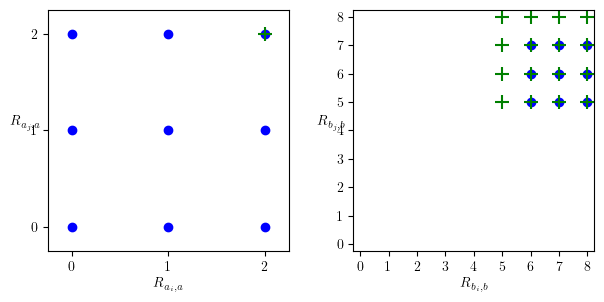
At \(Q_a = 2\) and \(Q_b = 8\) there are group evaluations for both labels that satisfy the safety specification.
# The question numbers that has group evaluations that DO NOT satisfy the safety specification
ntqr.plots.plot_pair_logical_alarm_at_qs(labels, ['i','j'], (7,3),[(2,8),(3,7)], plt=plt)
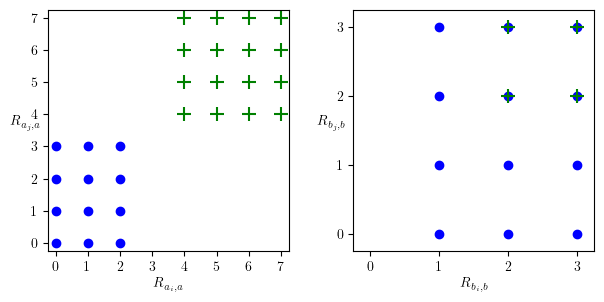
Here we can see that the ‘a’ label has to group evaluation with question numbers \((Q_a = 7, Q_b = 3)\) where both classifiers are better than 50% for both labels.
Three class classification, the R=3 case
# The basic unit of the alarms are comparisons between pairs of classifiers in an ensemble
# For each classifier we create its individual axioms
# We now have three labels for two classifiers
labels = ['a', 'b', 'c']
c1axioms = ntqr.r3.raxioms.SingleClassifierAxioms(labels, 'i')
c2axioms = ntqr.r3.raxioms.SingleClassifierAxioms(labels, 'j')
# Let's make an alarm for a small test, Q=10 questions.
alarm = ntqr.alarms.SingleClassifierAxiomsAlarm(10,
                                               (c1axioms, c2axioms),
                                               ntqr.r3.evaluations.SingleClassifierEvaluations)
# We want the classifiers to be better than 1/2 for both labels
alarm.set_safety_specification([2,2,2])
# We look at responses that make the pair misaligned at some
# question number settings for this Q=10 test.
trace = alarm.misalignment_trace([(5,3,2),(2,3,5)])
# Collect the qs under their test val
{key:[qs for val,qs in group]
 for key,group in itertools.groupby(
     sorted([(test_val, qs) for qs, test_val in trace]),lambda x: x[0])}
{False: [(2, 5, 3), (3, 4, 3), (3, 5, 2)], True: [(0, 0, 10), (0, 1, 9), (0, 2, 8), (0, 3, 7), (0, 4, 6), (0, 5, 5), (0, 6, 4), (0, 7, 3), (0, 8, 2), (0, 9, 1), (0, 10, 0), (1, 0, 9), (1, 1, 8), (1, 2, 7), (1, 3, 6), (1, 4, 5), (1, 5, 4), (1, 6, 3), (1, 7, 2), (1, 8, 1), (1, 9, 0), (2, 0, 8), (2, 1, 7), (2, 2, 6), (2, 3, 5), (2, 4, 4), (2, 6, 2), (2, 7, 1), (2, 8, 0), (3, 0, 7), (3, 1, 6), (3, 2, 5), (3, 3, 4), (3, 6, 1), (3, 7, 0), (4, 0, 6), (4, 1, 5), (4, 2, 4), (4, 3, 3), (4, 4, 2), (4, 5, 1), (4, 6, 0), (5, 0, 5), (5, 1, 4), (5, 2, 3), (5, 3, 2), (5, 4, 1), (5, 5, 0), (6, 0, 4), (6, 1, 3), (6, 2, 2), (6, 3, 1), (6, 4, 0), (7, 0, 3), (7, 1, 2), (7, 2, 1), (7, 3, 0), (8, 0, 2), (8, 1, 1), (8, 2, 0), (9, 0, 1), (9, 1, 0), (10, 0, 0)]}
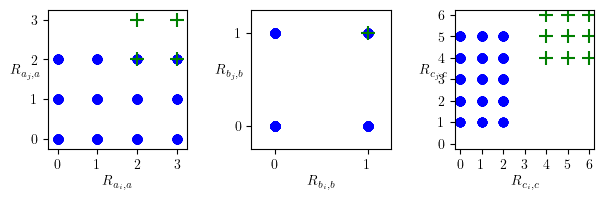
# The question numbers that has group evaluations that does not satisfy the safety specification
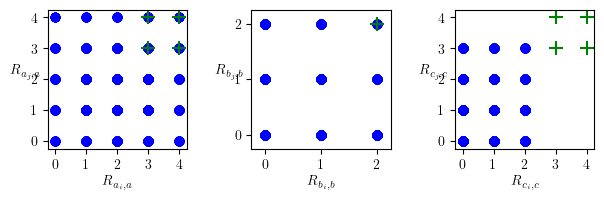
ntqr.plots.plot_pair_logical_alarm_at_qs(labels, ['i','j'], (3,1,6),[(5,3,2),(2,3,5)], plt=plt)
# Now a pair that is not logically misaligned (i.e. there exist questions numbers that satisfy the safety specification)
trace = alarm.misalignment_trace([(5,3,2),(4,3,3)])
# Collect the qs under their test val
{key:[qs for val,qs in group]
 for key,group in itertools.groupby(
     sorted([(test_val, qs) for qs, test_val in trace]),lambda x: x[0])}
{False: [(2, 5, 3), (3, 4, 3), (3, 5, 2), (4, 3, 3), (4, 4, 2), (4, 5, 1), (5, 2, 3), (5, 3, 2), (5, 4, 1), (5, 5, 0), (6, 1, 3), (6, 2, 2), (6, 3, 1), (6, 4, 0), (7, 0, 3), (7, 1, 2), (7, 2, 1), (7, 3, 0)], True: [(0, 0, 10), (0, 1, 9), (0, 2, 8), (0, 3, 7), (0, 4, 6), (0, 5, 5), (0, 6, 4), (0, 7, 3), (0, 8, 2), (0, 9, 1), (0, 10, 0), (1, 0, 9), (1, 1, 8), (1, 2, 7), (1, 3, 6), (1, 4, 5), (1, 5, 4), (1, 6, 3), (1, 7, 2), (1, 8, 1), (1, 9, 0), (2, 0, 8), (2, 1, 7), (2, 2, 6), (2, 3, 5), (2, 4, 4), (2, 6, 2), (2, 7, 1), (2, 8, 0), (3, 0, 7), (3, 1, 6), (3, 2, 5), (3, 3, 4), (3, 6, 1), (3, 7, 0), (4, 0, 6), (4, 1, 5), (4, 2, 4), (4, 6, 0), (5, 0, 5), (5, 1, 4), (6, 0, 4), (8, 0, 2), (8, 1, 1), (8, 2, 0), (9, 0, 1), (9, 1, 0), (10, 0, 0)]}
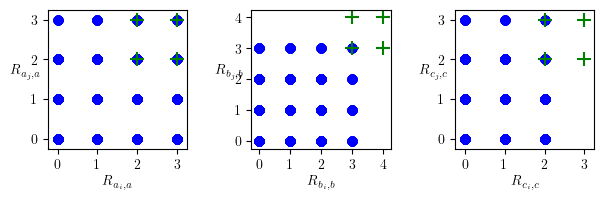
# The question numbers that has group evaluations that satisfy the safety specification, (3,4,3)
ntqr.plots.plot_pair_logical_alarm_at_qs(labels, ['i','j'], (3,4,3),[(5,3,2),(4,3,3)], plt=plt)
# All the label pair evaluations touch at least one of the green cross values
# The question numbers that has group evaluations that does not satisfy
# the safety specification, (4,2,4)
# Here the 1st classifiers 'i' is not greater than 50% for the c-label
ntqr.plots.plot_pair_logical_alarm_at_qs(labels, ['i','j'], (4,2,4),[(5,3,2),(4,3,3)], plt=plt)
# The 'c' label performance for classifier 'i' is violating the safety specification at qs = (4,2,4)